I was a young and excitable undergraduate when first I laid eyes on the enchanting theory of relativity. Never will I forget the sound of my jaw dropping when our professor casually stated that simultaneity is relative and that moving clocks run slow, which prompted me to ask “what do you, as a physicist, mean when you speak of time?”1
The purpose of this question was to gain some intuition for the relative theory of time and thereby gain a deeper understanding of the discovery. After all, the fact that a cannonball and feather experience the same acceleration in free fall is completely unintuitive. Our initial reaction to witnessing this fact is one of confusion and disbelief which stem from reasoning based on an incomplete picture of the world i.e. “the heavier ball is pulled much harder so it must fall faster”. However, in light of Newton’s second law i.e. “the heavier ball needs much more force to equally accelerate”, the result seems almost obvious.
The aim of this essay is to reveal the common flaws in our logical conception of time in an effort to demystify the results of special relativity. Some may argue that this is not necessary since appealing to correct mathematical manipulation will always lead to the desired results. This is certainly true provided that one is manipulating an expression which precisely captures their desired physical problem and is further capable of interpreting the results. This requires a good understanding of the link between physical concepts and their mathematical representations, which can easily be lost in the trails of symbolic acrobatics:
“Our symbolic mechanism is eminently useful and powerful, but the danger is ever-present that we become drowned in a language which has its well defined grammatical rules but eventually loses all content and becomes a nebulous sham.”- Cornelius Lanczos
Understandably, the classic approach to special relativity begins with the well-justified postulate that the speed of light is constant in all inertial reference frames. While mathematically palatable, this approach is conceptually difficult in that the consequences are not so intuitively appealing. I discovered an alternative and much more satisfying presentation in the exceptionally lucid works of Einstein and Reichenbach which I will follow once more2.
The Measurement of Time
First, let us recall that Physics concerns itself purely with measurable quantities. That is, no quantity should exist in the framework of physics if we haven’t agreed on how to measure it.
Measurement of time is fundamentally achieved by the observation of periodic processes, that is, processes which ideally repeat exactly e.g. a pendulum swinging back and forth while maintaining the amplitude of its swing. When we say that we are measuring time, we are in fact only counting the number periods completed by some periodic process.
A crucial question comes to mind: can we tell if successive periods of an ideal clock last the same amount of time?
At first sight, it would appear that they must last the same amount of time. However, Einstein pointed out that unless there exists some experiment through which we can test whether or not this is true, then any answer to this question is valid as a definition since it is empirically undecidable- we have no way of deciding if it is true or false.
In order to measure the duration of each period of a given test clock, we need to make use of another reference clock, perhaps operating by a different mechanism. Suppose that the reference clock shows that successive periods of the test-clock elapse over different times. You may be tempted to deduce that our test-clock is non-uniform however this would only follow if we already knew that our reference clock was uniform. We are not allowed to assume this since we would have to prove it by means of an experiment similar to this one. Therefore, from these observations, we can only deduce that each clock is non-uniform with respect to the other.
Suppose instead that the reference clock shows that successive periods occur in equal times. Even then, it does not necessarily follow that those periods last for the same amount of time. A correct deduction would be that the clock periods are synchronised i.e. if they are both non-uniform, then they are non-uniform in exactly the same way.
This question is, in fact, a pseudo-problem because it takes us into a logical circle: we count periods to tell time, but to tell if two periods last the same amount of time we would have to count periods. You may object, calling the laws of physics to your aid in an attempt to escape this vicious circle.
The problem is that the laws themselves are built on this very definition. That two successive periods of an ideal clock last the same amount of time is not a matter of knowledge but is a matter of arbitrary definition up to the requirement that any period lasts a strictly positive amount of time3.
The price of changing this definition is an unnecessary alteration to the laws of physics which teaches us nothing new and introduces unnecessary complications. Any “new effects” can ultimately be traced back to our unnatural definition of time. More on this in another essay.
Whichever definition we choose to employ, we should be able to come up with laws of physics which make correct predictions simply because we determine the laws after we make this definition. The resulting simplicity of our laws will directly depend on the definitions we choose to employ so, until we run into a local universal force i.e. one whose effect varies from one place or time to another, let us assume that there are no such forces exist (see my previous essay if you missed the discussion on universal forces and coordinative definitions4)
The Relativity of Simultaneity
Having dealt with the local measurement of time, we must now examine the comparison of time at different locations. The central concept which gives rise to all the apparent weirdness of special relativity is that of the simultaneity of distant events.
In the past, it was commonly believed that it is always possible to provide an absolute answer to the question “did the spatially-separate events A and B occur simultaneously?”
Absoluteness dictates that error-free measurements of any observer using any set of coordinative definitions would lead to the same answer.
Conversely, relativity dictates that error-free measurements made by different observers can lead to alternative but equally valid answers, each of which depends on some choice of coordinative definition.
Such a proposition is not necessarily illogical: if I asked you to determine the order of three sliding beads on a circular ring without any additional information, you will find that you are able to manipulate them so that any bead is the ‘first’ and any bead is ‘last’.
So how does this relate to our measurements of time? Before we get there, we must precisely define what is meant by the statement “the events A and B occurred simultaneously.”
If an event occurs at a distant location, how do we come to the knowledge that it has occurred? The answer to this question is summarised by one word: news. When a plate breaks, we receive the news of it breaking by sound or sight or the sudden silence that ensues. In all cases, there is a slight delay between the event actually occurring and the news arriving at our location because the speeds of the messengers, of light and sound, are finite.
The faster the messenger or the closer the scene, the closer we are to knowing the state of that scene in our present moment. The speed of light is so great that the delay is practically unnoticed over relatively short distances. This is why we are inclined to believe that whenever we look around, we are observing the present moment of everything we see when, in fact, the further away we look, the further in the past is the scene we see:
If we receive the news that an event just occurred in the Amazon, and we know that it took the messenger two days to deliver the news, then our news of current events in the Amazon is ironically two days old: we have no idea what is happening there in our present moment!
Physically speaking, time is a means of ordering of events: to say that “events A and B occurred simultaneously” is to essentially say “we do not know which one happened before the other”. In other words, we cannot order these events in time.
This lack of knowledge could be technical, due to limitations in the precision of our instruments, or it could be logical, due to the possibility that they actually occurred simultaneously implying that they truly cannot be ordered in time. We will concern ourselves only with the latter possibility.
Let us examine a realistic situation of relative simultaneity in a thought experiment. Consider the following accurate depiction of a duel and let us assume that second shooter doesn’t see the bang before he shoots.

Is it possible to tell who fired first?
It is very tempting to jump the gun and say it’s obvious, however, let us pause for a moment and suppose that both actually did pull the trigger simultaneously.
Since our perspective is closer to one shooter, we receive news of the bang happening first so we believe that he shot first. Similarly, an observer positioned closer to the other shooter would believe that they shot first. Finally, a special observer, who lies somewhere between the two shooters, will receive the news of both shots being fired at the same time.
From this information, our individual observers cannot determine the actual order of the two distant events, but they can order the arrival of news from the events. If an investigator tries to work out what really happened, they would find that the task is impossible from the observers’ accounts alone!
If the speed of the messenger is finite, then, as demonstrated above, then it is possible for observers to arrive at alternative, equally valid, accounts of the order arrival of the news from two spatially separate sources.
Without a faster messenger, the only situation where all will necessarily agree on the order is when the news from the first source arrives at the location of second source before it provides a broadcast.
Why? Because this ensures that no observer will hear the second broadcast before the first one, no matter how close they are to the second source.
On the other hand, if the speed of the messenger is infinite, then there will be no delay between any event happening and news of it arriving at any distant location. Therefore, all observers will always agree on the order of arrival of the news implying that the investigator, as well as the observers, will be able to correctly order all events.
One may object and claim that, with knowledge of the speed of the messenger and the distances between the observers and the events, it is possible for the investigator to work out the correct order of the events and thus determine who fired first.
However, as Einstein pointed out, we are not allowed to assume knowledge of the speed of our messenger without first being able to tell if two distant events occurred simultaneously. This may be very surprising, but it can be demonstrated by examining how one determines the speed of a signal.

In principle, there is only one way which consists of sending a signal between two points A and B, separated by a distance 

Notice that in relating the expression 
One may still object and claim that we do not need to know the time at B if we simply place a mirror there and use the clock at A to work out how long it takes the signal to travel from A to B and return. However, this implicitly assumes that the speed of the signal is the same in both directions along l. We cannot confirm this assumption without knowing its time of arrival at B, which brings us back to the matter of synchronising distant clocks.
Thus we arrive at a circle once more: to decide if two distant events occurred simultaneously, we require knowledge of the speed of the messenger delivering the news, but to determine the speed of the messenger we need to have some means of deciding if two distant events occurred simultaneously.
Einstein escaped this circle by noticing it: the simultaneity of distant events is not a matter of knowledge, but a matter of definition. He went further still and provided a coordinative definition equivalent to the unfalsifiable6 assertion that the speed of light is the same in all directions (and in all inertial reference frames but we’ll get there in a later essay). If tR is the time indicated by clock A when the (light) signal returns from B, then Einstein’s definition is:

In general, one is allowed to make any definition of the following form:

Where ε is any number greater than zero and less than 1. This restriction is due to two facts: that the speed of light is finite so 

The deeper consequence is that the speed of light cannot be directly measured- it must in fact be implicitly defined.
Ultimately we cannot truly tell who shot first if we rely on light as our messenger- two investigators using different coordinative definitions can arrive at contradictory answers which are equally valid.
This suggests the following important generalisation to the definition of simultaneity:
If two spatially separate events are indeterminate as to time order, then they are said to be simultaneous.
However, one imperative fact holds regardless of the choice of coordinative definition of simultaneity: each shooter believes that they shot first i.e. neither one can claim that they pulled the trigger as a result of the other shooting first i.e. there is no cause-and-effect relationship between these two events.
One last thing: let us suppose that we are given two distant events and are told that one event is the cause of the other. Then we necessarily know that the cause occurred before the effect. If the events occurred simultaneously, then it is not possible for one to cause the other unless if there exists a signal which travels at infinite speed from the location of the cause to the location of the effect c.f. action at a distance.
Contrary to popular belief, this is not logically impossible. It is rejected empirically for one reason: there seems to be a finite limit to the speed of causal propagation equal to that of the speed of light in a vacuum, a fact which has been thoroughly tested by experiment.
At no point in this essay did we need to consider the motion of clocks to arrive at our conclusions. It was demonstrated, I hope, that a relative theory of time is as natural as an absolute theory of time and that the physical choice is ultimately decided by experiment. On this matter Reichenbach said:
“It is a serious mistake to believe that if the state of motion is taken into consideration, the relativity of simultaneity is necessary. Actually, the relativity of simultaneity has nothing to do with the relativity of motion. It rests solely on the existence of a finite limiting velocity for causal propagation.”- Hans Reichenbach
I think that’s enough content for one essay. I will further explore the concept of causality, simultaneity and their relationship with topology in the next essay of this series.
Thanks for reading!
1: Yes, I was that guy and yes I still recall the collective eye roll that swept across the lecture hall when I asked this question. I asked so many questions that QM became my nickname (I think it stands for Question Man).
2: Relativity: the Special and General Theory- Albert Einstein, The Philosophy of Space and Time- Hans Reichenbach. I seriously cannot overemphasise how exceptionally enlightening I found these books- read them if you ever get the chance!
3: The time at a certain point must be a monotonically increasing function: this is our time metric! Incidentally, this is a good place to clarify the physical difference between proper time and coordinate time. Proper time is the total number of periods recorded by the clock between two given events. Coordinate time is what we get when we coordinate a time to each period, and in some cases both are exactly the same.
4: A metrical coordinative definition is a spatial metric. Provided it has the properties of a metric, it is admissible as a definition i.e. it cannot be completely arbitrary. The key point to notice is that a coordinate system does not define the geometry of the space to which the system refers. Rigid rods would correspond to intervals on coordinate curves while a metric coordinates a distance to these intervals, giving rise to the geometry of the space. One of the reasons why physical space is modelled as a three dimensional manifold is to capture the notion that it fundamentally has no geometry until we equip it with a metric.
5: Escher’s lithograph “Relativity” exemplifies this: contrary to popular belief, the structure depicted is not another impossible structure, someone actually built it with Lego!
6: Provided that light is the fastest causal signal in the universe. Even if we do find something faster, we’d arrive at the same problem because we can’t test the fastest causal signal against itself without going round in circles.
 , a chance of getting an apple is
  , and a pear
  . We just divide the number of fruit of the requested kind by the total number of all fruit in the box. One particular property of this is that these probabilities sum to
  . What does that mean? Well, a sum of probabilities of getting an orange, an apple and a pear is a probability that you will get either an orange, an apple or a pear when you reach in and grab a fruit. Provided our assumptions – that you will indeed grab something and there are no other fruit in the box, this will obviously happen. It is called a sure event. This a fairly obvious, but crucial property – the sum of probabilities of all disjoint events, all different possible things that can happen, I mean, really all of them, must be equal to 1, because “something” will always happen.
 and a probability of a different, disjoint event (think about grabbing an orange vs grabbing an apple) is
  , the probability that either one of these independent events will happen is the sum of the probability of each one happening on it’s own i.e
  . This in general doesn’t work in quantum mechanics.
 and
and  . These strange asymmetric brackets are ‘kets’ from Dirac bra-ket notation, it is just a way physicist write quantum states. But qubits, as quantum objects, can also occupy other states, which are linear compositions of the two states above, or the states “between” them. In other words, it might be in a state
  , where
  and
and  are numbers. Complex numbers, in general. These are exactly the amplitudes I mentioned earlier. A system in this state is called a superposition, exactly because it is a sum of two different states with some amplitudes. Superposition is a kind of subjective concept – a quantum state is represented as a vector in some space, but whether this vector is a basis vector or not depends on the choice of basis, for example, mentioned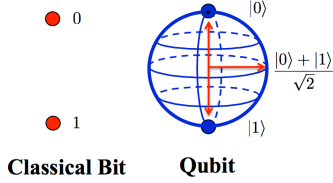
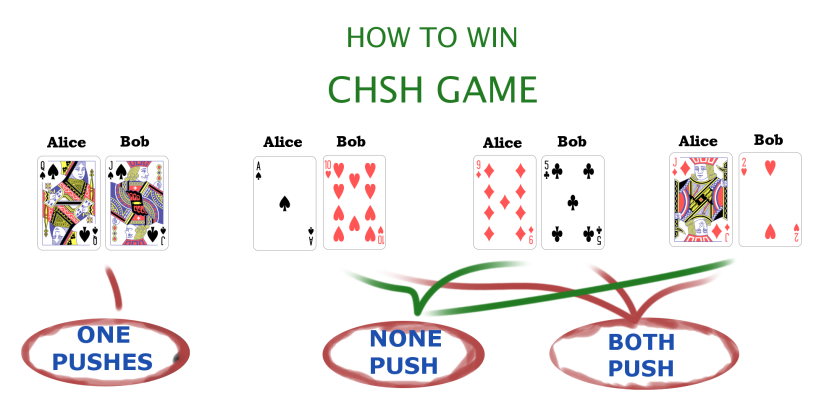
 of games if they just never push their buttons ever, because there is a 75% chance that at least one of their cards is going to be red. It can also be shown that it is the highest overall probability of winning for any strategy they are allowed to come up with.
 To be more precise, notice that if we take a planar slice through a spherical shell, it would be divided into two shells whose boundary is circle. Now recall that a circle, properly defined, is the collection of points which are equidistant from some point called the centre.
 and
and  .
. (1)
(1) is some constant.
 instead of (1) and will indeed be surprised to discover that their measurement of pi depends on the size of the circle they draw!
 against R.
 “How is this possible?” we wonder. “Maybe the construction process is inaccurate because the angles are not exactly right angles” someone suggests. So we instead attempt to simply ensure that the ends of the rods are the vertices of a closed quadrilateral: Euclidean geometry tells us that an equilateral quadrilateral is a rhombus. Instead, we are shocked to find that we necessarily end up with a trapezium instead. To be precise, as Flatlanders, we would find that there is only one pair of parallel sides if we were to measure the angles at each vertex.
 We are led to one of two conclusions: either Euclidean geometry is wrong or our rods do not have the same length. The second option is easier to stomach so we attempt to check that the rods are still equal in length: we compare the parallel sides by marking the vertices and switching the rods. We find, to our amazement, that we still end up with exactly the same shape. How can they possibly form a trapezium if the rods are of equal size when we compare them at both locations i.e. the parallel sides of the trapezium? Is Euclidean geometry wrong then?
 at some point and both have length
  at another point, but this does not imply that
  . More critically, there is no way of directly demonstrating nor indirectly deducing this relation without prior knowledge of our geometry.
 particles in that box, and so there is a plethora of exact configurations of their positions and momenta, the parameters that are in principle needed to fully, exactly describe the system. In most of them, the particles would appear to be almost evenly spread across the box. Now, let us think about the unusual configurations, when all the particles are in the right half of the box, and are randomly spread there. There are much fewer such configurations, so that is much less probable. How exactly?
 equally probable little spaces the particles can occupy, no matter how big these spaces actually are, then there are
  configurations in the case when particles can be spread out across the whole box. But in a half of the box there are only
  spaces, what means only
  configurations – a square root.
 is entropy,
  is a number of possible states – arrangements in this case, in general this also involves momenta, and
  is a Boltzmann constant. This equation shows that the entropy of a half filled container is a half of the entropy of a full container. It however assumes that each microstate has an exact same probability to occur. If the probabilities are different, equal to
  , the entropy changes to Gibbs’ form, given by
 -s by
-s by  , one over the number of microstates, which is a probability of a single microstate if they are all the same. This is because the minus sign in front inverts the argument of the logarithm.
 appears with probability
  , then entropy of a source is:
 letters long, with the most efficient coding we are going to need on average
  bits to encode it.
 ,
,  . We can calculate the entropy of this source:
 + 25%
+ 25%  . Exactly equal to the entropy value! Basically, the number of bits we aim to use for each letter should be as close as possible to
  , where
  . It can be then shown that if we introduce so-called binary entropy function
  the rate of compression has to be proportional to
  . The closer
  is to 1, the more bits we need in order to transfer the message. This makes sense,
  corresponds to
  , and that means we can have no idea whatsoever about what the message actually was, as exactly a half of the bits are flipped, so the message looks like a completely random string.